About Me
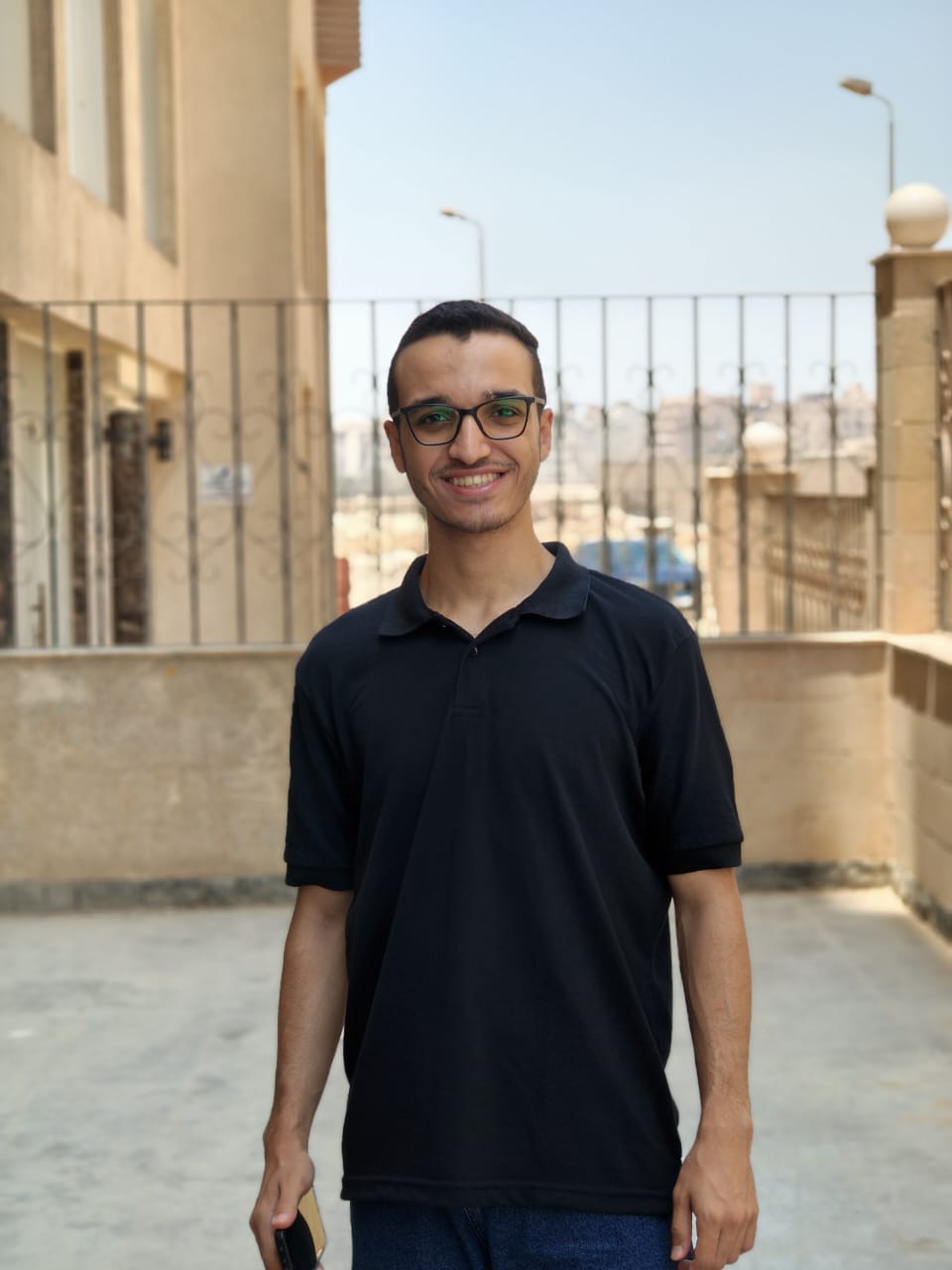
I'm a passionate Engineering student with a strong background in Machine Learning, Deep Learning, and their intersection with healthcare. I love solving real-world problems with data-driven approaches and intuitive design. Super interested in Computer Vision, NLP, and LLMs.
Education
Cairo University - Faculty of Engineering
Major: Systems and Biomedical Engineering
Expected Graduation: July 2027
Skills
- Programming Languages: Python (Proficient), Java, C++, Bash, JavaScript
- Libraries & Frameworks: Pytorch, TensorFlow, NumPy, Pandas, Matplotlib, Seaborn, Scikit-Learn
- Other: Git, Github, Linux, Docker, CI/CD, LaTeX
Experience
-
AI Developer Intern - Siemens EDA
July 2025 - August 2025
Implemented AI-driven functionality for Siemens’ tools using APIs, RAG System, large language models (LLMs), and prompt engineering.
Awards
- Nasa Space Apps Cairo Local Winners - Oct 10, 2024
- 4th Place – Undergraduate Engineering Mathematics Research Forum Cairo University – Technical Center for Career Development (TCCD) - Dec 2024
Featured Projects
Here are some of my recent projects that showcase my skills and passion for AI
Seq2Seq Model From Scratch
Implemented a Seq2Seq architecture based on Sutskever et al.'s paper "Sequence to Sequence Learning with Neural Networks".
- Developed an English–French translation system using this architecture with robust data preprocessing.
- Trained on Eng–Fra parallel 34,802 pairs corpus achieving 38.32 BLEU score.
- Achieved 172.75 sentences/sec inference speed.
Keras OpenVINO Contribution
Enhanced Keras' OpenVINO Backend by implementing support for the numpy.dot operation.
Authored and merged pull request #20982
that added the dot functionality, resulting in improved compatibility.
Alzheimer's Disease Modeling with PINNs
Developed Physics-Informed Neural Networks (PINNs) to model Alzheimer's disease progression:
- Enhanced model accuracy by optimizing a PINN architecture to capture tau protein diffusion-reaction dynamics, resulting in more reliable predictions of unknown PDE reaction terms.
- Expanded code functionality by incorporating machine learning techniques to predict reaction terms, leading to a robust and adaptable codebase.
- Advanced domain insights by integrating symbolic regression for interpretable reaction terms, thereby deepening understanding of Alzheimer's pathology.
Cars Model Classification
Fine-tuned MobileNetV2 on the Stanford Cars dataset (16k+ images, 196 classes).
- Achieved 86% test accuracy on large-scale car model classification.
- Explored transfer learning and fine-tuning strategies for improved performance.
Latest Posts
Thoughts on AI, Machine Learning, Deep Learning, and my engineering journey
Get In Touch
I'm always interested in new opportunities and collaborations. Let's connect!
Let's Connect
Whether you have a project idea, want to collaborate, or just want to say hello, I'd love to hear from you!